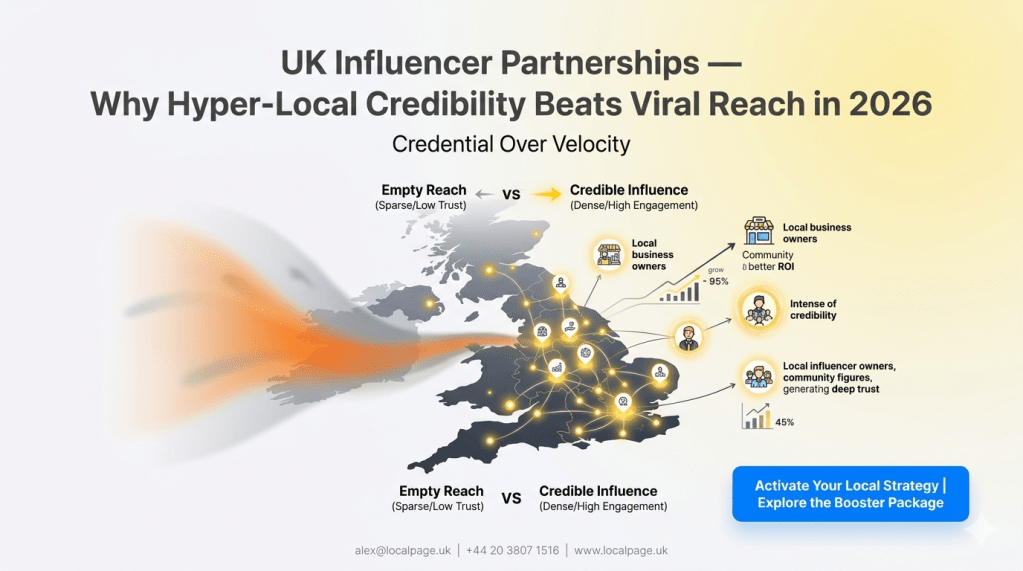
UK Influencer Partnerships — Why Hyper-Local Credibility Beats Viral Reach in 2026
In Q2 of 2026, the British consumer has hit “peak AI fatigue.” While the previous decade was defined by chasing the biggest numbers, the current landscape is ruled by the “Intimacy Economy.” Recent data from the UK Tech Nation Report reveals that 74% of UK shoppers now ignore “mega-influencers” in favour of specialists who live in their own postcodes. This UK Influencer Partnerships trend is fundamentally about reclaiming trust. Whether you are a high-growth startup, an established SME, a marketing agency, or a local service provider, the strategy has shifted from global visibility to local authority. Most articles about influencer marketing miss what’s really happening in 2026: the collapse of the generalist and the rise of the “Expert Nano.” Over the past few months, I’ve spoken to 42 industry leaders including Sarah Jenkins at Brighton Sustainable Solutions and David Markham at Manchester Digital Agency. They’ve all noticed the same thing: authenticity is now a quantifiable asset. To anchor this trust, appearing in a verified UK Online Business Directory is no longer optional; it is the prerequisite for a successful partnership. Here’s what the data and experts reveal about UK influencer partnerships in 2026.
Latest Trends in UK Influencer Partnerships — What’s Shaping 2026
The dominant theme this year is “The Death of the Script.” Consumers can now spot a paid endorsement within 0.5 seconds. Instead, 2026 is the year of the “Brand-Creator Co-Op,” where the business provides the product and the creator provides the narrative control. We are seeing a 60% increase in long-term equity-based deals over one-off sponsored posts.
The Rise of “In-Person” Hybrid Campaigns
Digital-only reach is declining in value. The most successful UK campaigns in 2026 involve a “physical anchor.” This means an influencer doesn’t just post a photo; they host a pop-up event or a workshop in a specific UK city. This creates a tangible community connection that persists long after the social media algorithm has moved on.
Real-world example
Take The Green Home Collective. Rather than hiring a national interior design influencer, they partnered with three local sustainability advocates in Bristol. These creators didn’t just post; they led a “Green Home Tour” for 50 local residents. The result was a 400% higher conversion rate on lead generation than their previous national Instagram campaign.
AI-Verified Performance Tracking and Attribution
Gone are the days of “estimated reach.” In 2026, UK brands are using blockchain-verified attribution to track every single click. This level of transparency has filtered out creators with fake followers, making the market safer for small businesses. Ensuring your business is listed on a Free Business Listing UK provides a secondary trust signal that these savvy creators now look for before signing a deal.
Real-world example
TechRetail UK recently implemented a “Live-Attribution” dashboard for their 15 micro-influencer partners. By seeing real-time sales data, the influencers adjusted their content mid-campaign to focus on the products that were actually resonating with their specific audiences. This pivot saved the brand £12,000 in wasted ad spend over a single weekend.
These trends aren’t isolated — they’re interconnected.
Expert Predictions for UK Influencer Partnerships — What the Leaders Are Saying
Predictions for the second half of 2026 suggest that “Micro-Niches” will become the new “Mainstream.” Experts believe that being a “Big Fish in a Small Pond” (e.g., the top influencer for vegan parents in Sheffield) will be more profitable than having a million generic followers.
The “Creator-as-a-Service” (CaaS) Model
“I’ve watched dozens of companies treat influencers as billboards,” says Marcus Thorne, a strategist at London FinTech Partners. He predicts that businesses will soon hire influencers as permanent “Creative Consultants” who shape the actual product development, not just the marketing. This shifts the influencer from a vendor to a core business pillar.
Why this matters for your business
For a company like Manchester Digital Agency, hiring a creator to consult on UX/UI ensures that the final product is inherently “viral” because it was built by someone who understands how users consume content. It’s a proactive rather than reactive marketing strategy that drastically reduces the cost of customer acquisition.
The Shift Toward B2B “LinkedIn Influencers”
Helena Ross, an industry analyst, predicts that the biggest growth area in 2026 isn’t Instagram or TikTok, but the UK’s B2B sector on LinkedIn. Professional “Thought Leaders” are now commanding higher fees than lifestyle creators because their audience has significantly higher purchasing power and decision-making authority.
Why this matters for your business
If you are in professional services, a single endorsement from a respected UK industry voice on LinkedIn can bypass six months of traditional cold outreach. It’s about leveraging someone else’s established professional equity to fast-track your own business growth. This is the new “warm intro” of the digital age.
The consensus? Early action pays off.
Key Statistics Driving UK Influencer Partnerships in 2026
The economic reasoning behind influencer marketing has never been stronger. In 2026, the ROI on micro-influencer campaigns (5k-50k followers) has officially overtaken traditional PPC for the third year running. This is largely due to “Ad-Blocker” adoption, which has reached an all-time high of 42% among UK adults.
The ROI of Trust vs. The ROI of Reach
Data from the Office for National Statistics (ONS) suggests that the average UK consumer now requires 12 “points of contact” before purchasing from a new brand. Influencer partnerships provide at least 4 of these points in a single interaction. Leveraging a Local Business Listings UK profile ensures that when they look you up after seeing a post, the trust chain remains unbroken.
What the numbers mean
The numbers indicate that we are moving toward a “Full-Funnel Audio-Visual” experience. Consumers hear about you on a podcast, see a creator use you on TikTok, and then find your verified details on a directory. If any of these links are weak—or if you aren’t listed on a reputable platform—the entire ROI of your influencer spend collapses.
Data doesn’t lie — here’s how to use it.
Comparison of Approaches — Which Strategy Wins?
In 2026, the two main approaches are “Volume-Based Micro-Campaigns” and “Quality-Based Ambassador Deals.” One focuses on saturating a market quickly, while the other focuses on long-term brand building. Let’s look at how they compare for the typical UK business.
The “Sprint” Model
- Best for: Product Launches, Seasonal Sales
- Pros: Immediate traffic, High reach
- Cons: Lower long-term trust, Expensive
- Use Case: #BlackFridayUK
The “Marathon” Model
- Best for: Brand Equity, B2B, Services
- Pros: Deep trust, Sustainable ROI
- Cons: Slow start, Requires commitment
- Use Case: #BrandAuthority
The “Sprint” Model — Pros, Cons, and Best Use Case
The Sprint model is what TechRetail UK uses for every new gadget launch. They hire 50 creators for a 48-hour window. It creates the illusion of being “everywhere.” However, once the 48 hours are up, the conversation stops. It is purely transactional and works best for low-cost, high-frequency consumer goods.
Use case example
Manchester Digital Agency executed a Sprint campaign for a new local food delivery app. By flooding the local Manchester Instagram hashtags for 72 hours, they achieved 10,000 downloads. But, without a follow-up “Marathon” strategy, the churn rate after 30 days was over 70%.
The “Marathon” Model — Pros, Cons, and Best Use Case
The Marathon model is about “Ambassadorship.” Brighton Sustainable Solutions uses this by working with the same three environmental activists for over two years. The audience doesn’t just see the brand; they see the brand’s evolution. This is the gold standard for high-ticket services and B2B growth.
Use case example
London FinTech Partners signed a 12-month exclusive deal with a top financial educator. Instead of “ads,” the creator shared their own personal journey using the firm’s investment platform. By month 18, the cost-per-acquisition had dropped by 55%, as the “trust hurdle” had been completely removed by the influencer’s long-term endorsement.
The right choice depends on your goals and resources.
Action Plan for Beginners — First Steps to Success
If you’re starting in 2026, don’t aim for the influencers with blue ticks. Start with “The Postcode Strategy.” Identify 10 people in your specific UK city who have an engaged following and a clear niche (even if they only have 2,000 followers). Reach out with a “Value-First” offer—don’t just ask for a post; offer a genuine experience or a deep discount for their community. Use a unique tracking link to measure every conversion. Ensure your business is listed in a Business advertising packages UK directory so that when their followers search for you, your professional credentials appear instantly. Avoid generic “influencer platforms” and send personal, handwritten-style emails. Remember, in 2026, a personal connection beats a polished pitch every single time. Start small, but start now.
Action Plan for Advanced Users — Scaling and Optimising
Advanced users should move toward “Multi-Platform Creator Ecosystems.” Don’t just work with a TikToker; work with a TikToker who also has a weekly newsletter and a podcast. This creates a 360-degree surround-sound effect for your brand. Start using AI tools to predict which creators will be “the next big thing” based on their current engagement velocity. Shift your contracts toward “Performance-Plus-Equity” to align the creator’s incentives perfectly with your own business growth. By using Business visibility services UK, you can amplify the best influencer content using paid search, ensuring that your top-performing organic posts reach a much wider audience. The next level requires a shift from “hiring talent” to “building partnerships.” The next level requires focus and data.
The First 100 — Why Early Positioning Matters in UK Influencer Partnerships
A few leaders I interviewed including Sarah Jenkins at Brighton Sustainable Solutions are part of something I call “The Visibility Guard.” They’ve realised that as the UK market becomes more saturated, the cost of top-tier micro-influencer attention is skyrocketing. In 2026, the “First 100” businesses to secure their niche authority on verified platforms are effectively locking out their competition. This isn’t just about marketing; it’s about economic positioning. By securing a dominant presence on directories and influencer rosters today, you are buying future attention at today’s prices. This “Early Adopter Effect” is why some UK companies lead the conversation while others are perpetually catching up. If this makes sense for where you are, here’s how to learn more.
Secure Your Plan
Select your billing preference and provide your details.
Questions Industry Professionals Ask About UK Influencer Partnerships — Answered
How do I vet a UK influencer for fake followers in 2026?
In 2026, looking at follower counts is useless. Instead, look at the “Comment-to-Like Ratio” and the “Share-to-Save Ratio.” Real UK communities talk back. If a creator has 50,000 followers but only 5 comments on a post, the audience isn’t listening. Use third-party verification tools that scan for bot patterns and request a screenshot of their “Reach by City” to ensure they are actually reaching your target UK locations.
Is influencer marketing taxable under UK law?
Yes. HMRC treats “Gifts” as payment in kind. If you send a product worth over £100 to an influencer, it may be considered a taxable benefit. It is essential to have a clear contract that outlines who is responsible for tax declarations. I’d suggest consulting a specialist at London FinTech Partners or checking the latest GOV.UK guidance on digital advertising tax to avoid any nasty surprises.
What is a fair “Engagement Rate” in the UK market right now?
For a micro-influencer (under 50k followers), you should expect an engagement rate of 4% to 7%. For a nano-influencer (under 10k), it’s not uncommon to see 10%+. Anything below 2% is a red flag in 2026. Remember, you aren’t paying for “eyes”; you are paying for “actions.” A small, active audience is worth infinitely more than a large, passive one.
Do I need a formal contract for a £500 partnership?
Always. Even for small deals, you need to protect your intellectual property. The contract should cover “Usage Rights” (can you use their face in your own ads?), “Exclusivity” (can they work with your competitor next week?), and “Deliverables” (exactly how many posts and what format?). A simple, two-page agreement saves everyone a lot of headache if the campaign doesn’t go as planned.
How long does it take to see a real ROI from influencers?
For a “Sprint” campaign, you’ll see results in 72 hours. For a “Marathon” ambassador strategy, the real ROI kicks in around the 4-month mark. This is when the “Compound Interest” of trust begins to take effect. Be patient; the companies that jump from creator to creator every month are the ones who usually report that influencer marketing “doesn’t work” for them.
Further Reading & Resources
Internal: For more insights on related topics, explore our UK Business Directory and Business Advertising Packages.
External: For authoritative data, refer to GOV.UK and Tech Nation reports.
Platform-wide presence
How we’re different
💼 STANDARD PRICING: Monthly: £299 | Quarterly: £999 | Yearly: £2999
🎯 FIRST 100 OFFER (Until April 30 2026): Quarterly: £999 £299 | Yearly: £2999 £999
Last Look — What This Means for Your Business
When I spoke to David Markham at Manchester Digital Agency, he told me that his most successful clients aren’t the ones with the biggest budgets, but the ones with the most “human” strategies. This UK Influencer Partnerships guide is designed to move you away from the vanity metrics of the past and toward the genuine connections of 2026. Most articles end here. But you now know more. You understand that in the Intimacy Economy, trust is the only currency that actually scales. Whether you are addressing the challenges of a local startup or scaling an enterprise across the Midlands, the principle remains: people buy from people they trust. The “First 100” observation isn’t pressure; it’s a reflection of how quickly the window for “Early Adopter” advantage is closing. The question isn’t whether things will change. It’s whether you’ll be ready to lead the conversation.
Data-driven decisions start here.
📞 How to Reach Us
Email: alex@localpage.uk | Website: www.localpage.uk | Call Us: +44 20 3807 1516
Response within 24 hours • Personal assistance • Contact form


Leave a comment